Battery tester
Battery tester: test a battery with your multimeter and phone
A multimeter tells you a battery's voltage; the battery tester tells you what that voltage means. Pick the battery you have, touch the probes to it, and the app shows FULL, GOOD, WEAK or the end of its life, in words, with the next step. It works with the Bluetooth meters the app reads live, and it is free.
iPhone and iPad (iOS 17 or later): free on the App Store. Android later.
How a test goes
- Set the meter to DC volts.
- On the Tests tab, open Quick tools › Battery tester and pick the battery: AA, AAA, 9V, a coin cell, an 18650 or a 12 V car battery.
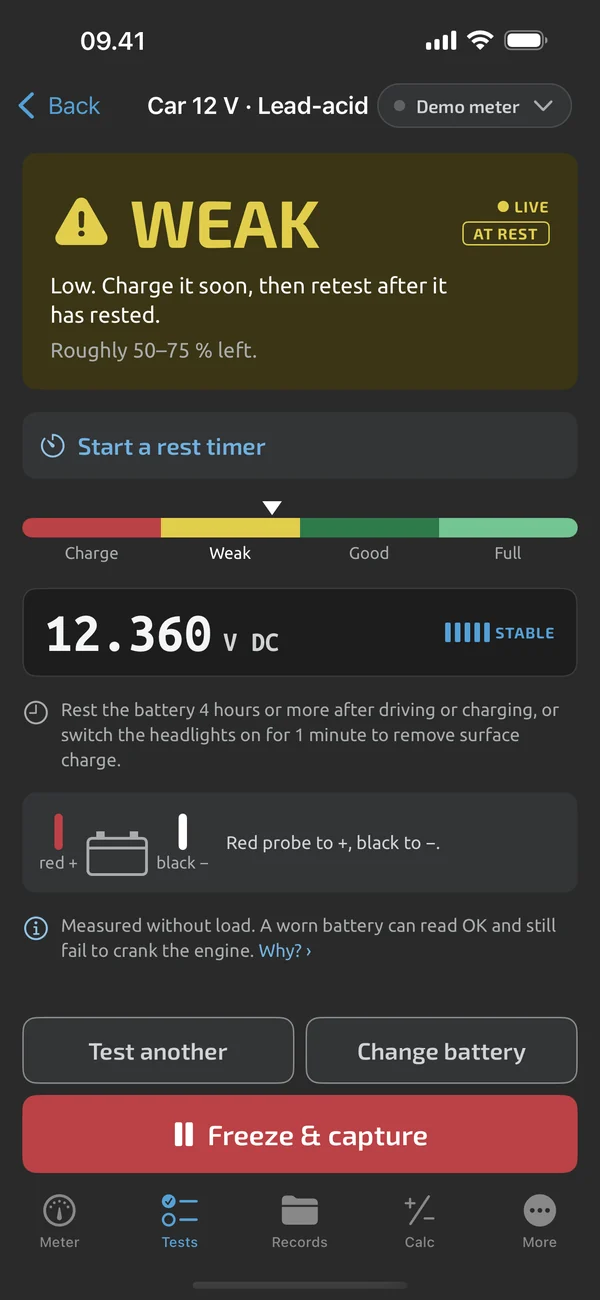
- Touch the red probe to + and the black probe to −, and hold them still until the five stability bars are lit.
- Read the verdict card: the word, one line with the next step, and a rough charge where the battery's voltage tracks it.
Under the card, a band ruler puts a marker at the live value on four bands, from the battery's low action (Replace, Recharge or Charge) through Weak and Good to Full, and the large readout shows the volts with the digits that have settled. Test another waits for you to lift the probes and settle on the next battery of the same type.
The verdicts and what to do
| Verdict | What it means | What to do |
|---|---|---|
| FULL | As good as new. | Use it. |
| GOOD | Plenty left. | Use it. |
| WEAK | Most of the charge is used. | Low-drain devices only, or soon. Rechargeables: recharge soon. |
| REPLACE | Empty for most devices. | Replace it and recycle the old one. |
| RECHARGE | A rechargeable cell that is empty. | Recharge it. |
| CHARGE & RETEST | A 12 V car or AGM battery that is low. | Charge it fully, let it rest, measure again. Still low: replace it. |
Below 3.00 V an 18650 or 21700 Li-ion cell shows OVER-DISCHARGED. Hearing-aid (zinc-air) cells show only OK or REPLACE, because they hold about 1.4 V until they are nearly empty. The colour is always next to the word, never on its own.
Battery voltage chart (no load)
These are the bands the app uses, measured with nothing drawing current. The charts are generated from the same table as the app, so they cannot drift apart.
| Verdict | AA alkaline, AAA alkaline, C / D alkaline | 9V alkaline | CR2032, CR2025, CR2016, CR2450, CR123A | LR44 alkaline button |
|---|---|---|---|---|
| FULL | 1.55 and up | 9.30 and up | 3.15 and up | 1.55 and up |
| GOOD | 1.45 to 1.55 | 8.70 to 9.30 | 3.00 to 3.15 | 1.45 to 1.55 |
| WEAK | 1.30 to 1.45 | 7.80 to 8.70 | 2.80 to 3.00 | 1.35 to 1.45 |
| Below Weak | under 1.30REPLACE | under 7.80REPLACE | under 2.80REPLACE | under 1.35REPLACE |
Measured at rest, with nothing connected. A reading exactly on a boundary counts as the higher band.
| Verdict | AA NiMH, AAA NiMH | 18650 Li-ion, 21700 Li-ion | Car battery 12 V (flooded) | 12 V AGM |
|---|---|---|---|---|
| FULL | 1.35 and up | 4.10 and up | 12.60 and up | 12.80 and up |
| GOOD | 1.28 to 1.35 | 3.80 to 4.10 | 12.40 to 12.60 | 12.50 to 12.80 |
| WEAK | 1.20 to 1.28 | 3.60 to 3.80 | 12.20 to 12.40 | 12.20 to 12.50 |
| Below Weak | under 1.20RECHARGE | 3.00 to 3.60RECHARGE | 12.00 to 12.20CHARGE & RETEST | 12.00 to 12.20CHARGE & RETEST |
| Lower still | – | under 3.00OVER-DISCHARGED | under 12.00REPLACE | under 12.00REPLACE |
Measured at rest, with nothing connected. A reading exactly on a boundary counts as the higher band.
For a flooded car battery at rest, 12.60 V is about 100 % charged, 12.40 V about 75 % and 12.20 V about 50 %. The app also has lithium AA and AAA, SR44 silver oxide, hearing-aid cells, 12 V LiFePO4 and the 6 V lantern battery; their curves are flat or their sources few, so treat those bands as a guide. The numbers come from battery makers' datasheets, Battery University and common battery testers. Each battery family has its own page, starting from how to test a battery with a multimeter, and the free battery checker gives the same verdict for a voltage you type.
Chemistry matters more than size
A full NiMH rechargeable AA rests at about 1.35 to 1.40 V, which would look weak on the alkaline scale. A lithium AA holds about 1.80 V and drops only at the very end, so a nearly empty one would look full on it. That is why each tile in the picker is a size and a chemistry, and why a reading above the battery's range says Check the battery type.
Measured without load: what that means
The meter measures the battery while nothing draws current from it, the open-circuit voltage. That is a good guide for most batteries. It cannot see a worn battery's internal resistance: a cell can read GOOD and still fail in a camera flash, a toy motor or a car starter. The app's load test and car battery test measure the battery while it works; see below. For a battery under load over time, record a discharge curve. For aircraft batteries, the aircraft battery voltage check shows the charge-state table and the check a voltage cannot replace.
The test screen shows a prep line where it matters: let a car battery rest 4 hours after driving or charging, or switch the headlights on for 1 minute to remove the surface charge; pull the tab off a hearing-aid cell and wait 2 minutes. If the meter reports its own battery as low, a banner says so, because its readings may be off.
Freeze and keep the result
Freeze & capture freezes the verdict and the value and saves the reading as a normal capture in Records, labelled with the battery and the verdict, for example "Car battery 12 V (flooded) · WEAK". Add a note to it, such as which device it came from. To try the tester without a battery or a meter, connect the demo meter, which is labelled DEMO.
More battery tests in the app
The battery tester is the quick check. Six more tests go further, all free, and each result is kept with its battery.
Battery history
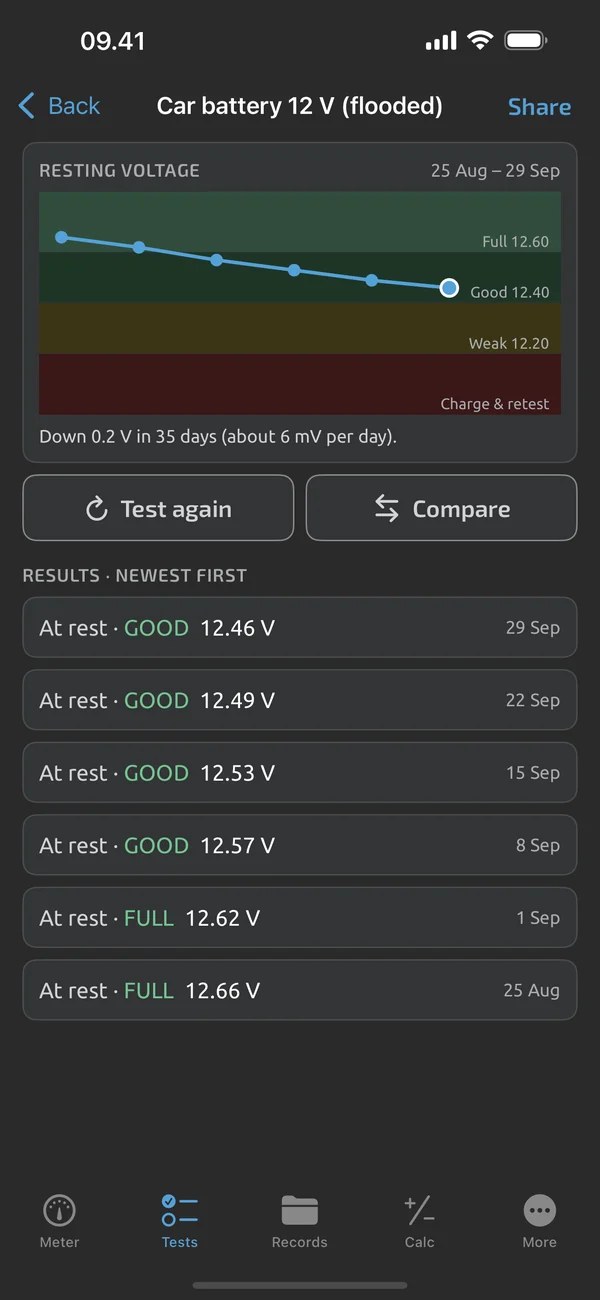
Every result is saved with the battery, the verdict and the values. The history lists each battery type you tested with its last verdict, and one battery shows its results over time with a trend of the resting voltage. Test again links a new result to an old one, Compare shows the difference between two, and Share makes an image of a result. The picker has a search field, a Recent row and room for batteries of your own.
Load test and internal resistance
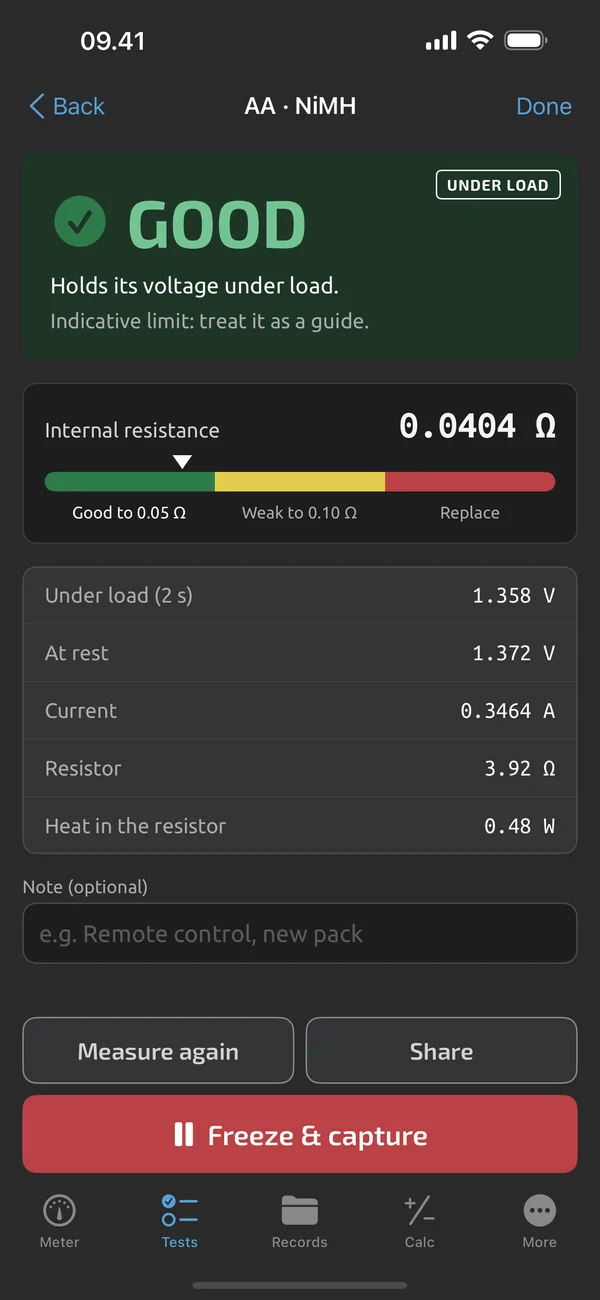
Put a resistor of your own across the battery for a few seconds: the app reads the voltage at rest and under load, works out the internal resistance and says whether the battery still holds up. It refuses a resistor that would draw too much current from that battery. More: battery internal resistance test.
Capacity test
How much charge a battery really gives: discharge it through a known resistor while the app records, and it works out the mAh and Wh. It catches worn cells and capacity claims that are too good to be true. More: battery capacity test.
Car battery and charging test
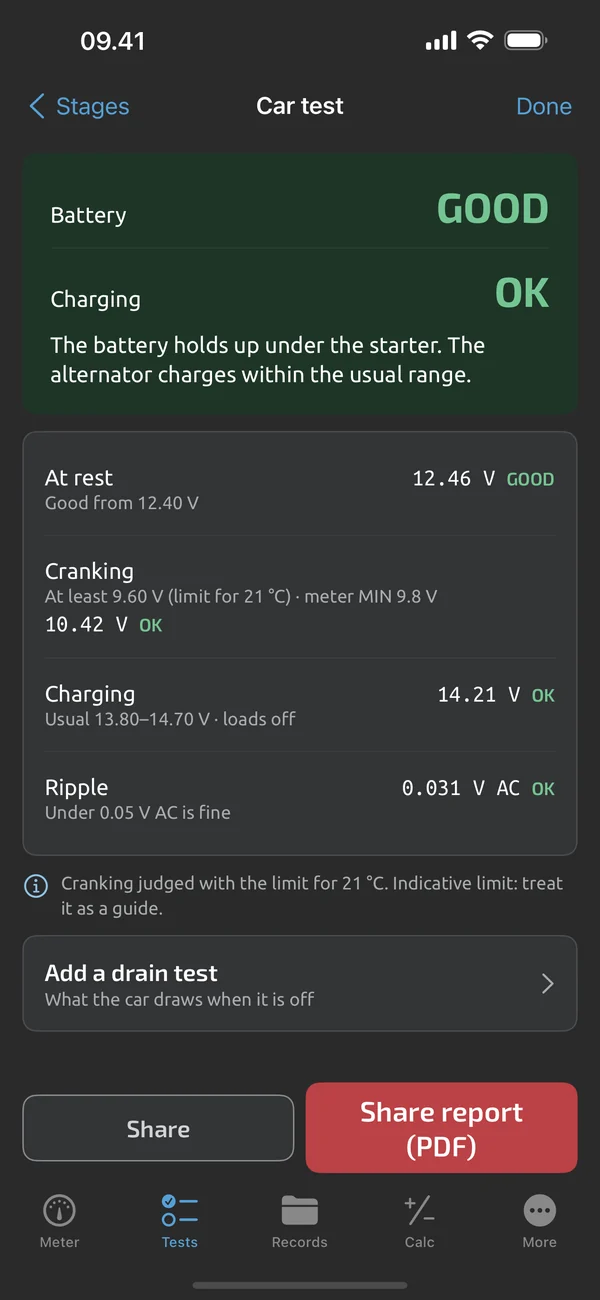
A guided test of a 12 V starter battery and its charging system: at rest, while cranking, while charging and the ripple of the alternator, ending in a one-page report you can share. More: how to test a car battery and how to test an alternator.
Parasitic drain test
What a car draws when it is switched off: the meter goes in series with the battery, and the app logs the current while the control units fall asleep and shows the curve against the 50 mA line. More: parasitic draw test.
Battery packs and cell balance
For packs of cells in series up to 60 V: e-bike and tool packs, LiPo packs, LiFePO4 batteries and lead-acid banks. The app judges the pack per cell, then you measure each cell at the balance connector and it shows the lowest and highest cell and the spread between them.
What it does and doesn't do (yet)
| What it does | Plan |
|---|---|
| Pick the battery type and see FULL, GOOD, WEAK or the end of its life from the DC volts, with the next step. | Free |
| Every battery result is kept with the battery, the date and the verdict, so you can see what was tested and how it changed. | Free |
| Put a known resistor across the battery for a few seconds and judge the voltage under load and the internal resistance. | Free |
| Measure the mAh and Wh a battery really gives, from a discharge recording through a known resistor. | Free |
| A guided test of a 12 V starter battery and its charging system: rest, cranking, charging and ripple, with a one-page report. | Free |
| Log the current a switched-off car draws while its control units fall asleep, against the 50 mA line. | Free |
| Check packs of cells in series up to 60 V, cell by cell: e-bike and tool packs, LiPo, LiFePO4 and lead-acid banks. | Free |
| A large readout that shows which digits have settled; OL and UL are shown as OL and UL, never as a number. | Free |
| Five stability bars show when a reading is steady. | Free |
| One tap saves the current reading, with an Undo. | Free |
| Add a text note and a short label to any capture. | Free |
| Shows the meter's battery, model and firmware where the meter reports them, and warns when its battery is low. | Free |
| A simulated meter lets you try the whole app without hardware; it is labelled DEMO everywhere. | Free |
Not yet, or not planned
- The load test is not offered for 12 V starter, lantern, zinc-air or LiFePO4 batteries; a car battery's cranking strength is checked in the car battery test.
- Battery results are saved as captures in Records and in the battery history, not as test files with a pass/fail run.
Questions
Can a multimeter test a battery?
It can measure the voltage, which shows how charged most batteries are. On its own it cannot measure how much current a battery can still deliver; that needs a load test. The battery tester turns the voltage into a verdict for the battery type you pick, and the load test adds a resistor of your own to judge the battery while it works.
What voltage should a good AA battery read?
An alkaline AA reads about 1.60 V when new. From 1.55 V it is FULL, from 1.45 V GOOD and from 1.30 V WEAK; below 1.30 V replace it. A NiMH rechargeable AA rests lower, about 1.35 to 1.40 V when charged.
What voltage should a 12 V car battery read?
At rest, at least 4 hours after driving or charging, a flooded car battery reads about 12.60 V when full, 12.40 V at about 75 % and 12.20 V at about 50 %. Between 12.00 and 12.20 V charge it and test again; under 12.00 V after a full charge, replace it. An AGM battery rests higher: it is full at 12.80 V.
Is the battery tester in the app today?
Yes. The battery tester and the six battery tests on this page are in the app on the App Store, and they are free.
Do I need a Bluetooth multimeter?
Yes, the tester reads the voltage live from a meter the app connects to; see the Meters page. The demo meter lets you try the screens without one.
Try it in the demo
A simulation of the app in your browser, with made-up readings: no meter and no install needed.
Get TestNMeasure for iPhone and iPad.
iPhone and iPad (iOS 17 or later): free on the App Store. Android later.


Questions or a meter to suggest? Mail support@testnmeasure.app.
No ad networks, no sign-up.